
Real talk about what actually works — and why most people skip the part that matters most
Let me be honest with you about something. I have read a lot of curly hair advice. A lot. And most of it either buries you in product recommendations or tells you to “listen to your hair” without ever explaining what that actually means. So this is my attempt at something different: three steps, explained properly, without pretending it’s simpler than it is or more complicated than it needs to be.
Curly hair breaks more than straight hair. That’s just physics. Every bend in a coil is a stress point, and when you add heat tools, dye, or even just years of ponytails on top of that, the damage compounds. But breakage is not inevitable. It’s usually predictable, and once you understand what’s actually happening at the strand level, you can do something about it.
Here’s where most people go wrong: they treat curly hair strengthening like a product problem. They buy the treatments, they apply them, they wonder why nothing changes. The issue is usually not the product. It’s the order of operations, and the consistency. Let’s fix that.
Step 1: Stop Putting Things on Dirty Hair
This sounds almost offensively simple. I know. Bear with me.
The honest reason most strengthening treatments don’t seem to work is that they never actually touch the hair. Product buildup, hard water deposits, and excess oil from your scalp create a physical barrier on the hair shaft. Anything you apply on top of that barrier sits on the surface and gets rinsed away. You’re essentially moisturizing your buildup, not your hair.
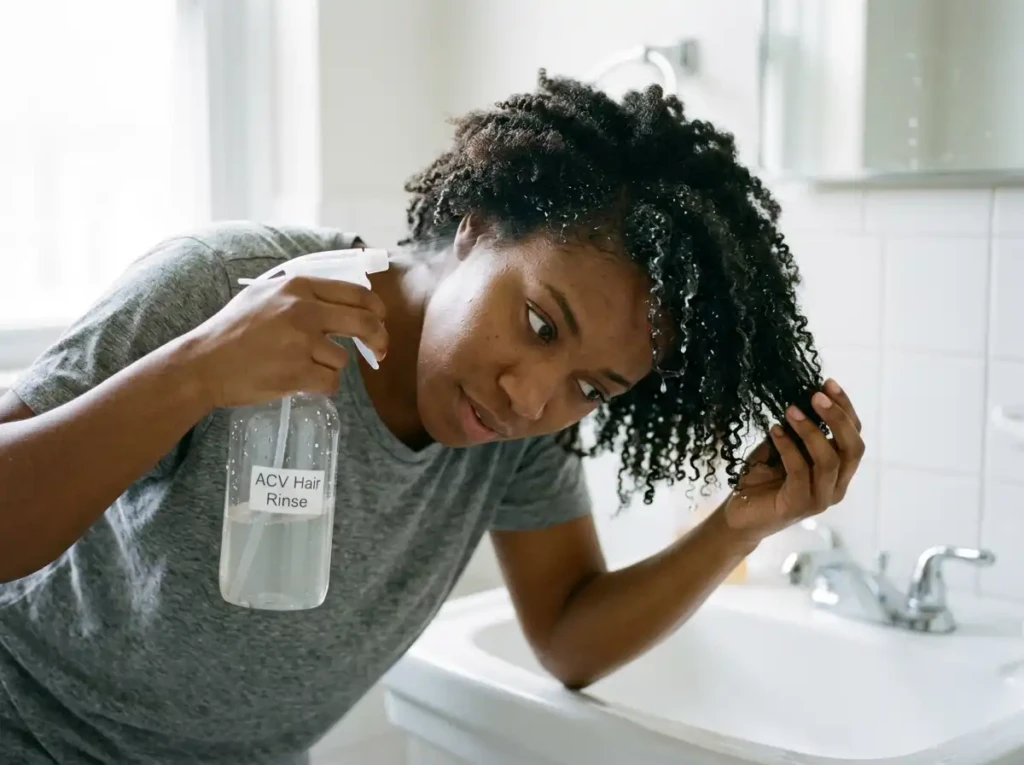
Once a month, use a clarifying shampoo or make an apple cider vinegar rinse: one part ACV to three parts water, applied after shampooing, left on for a few minutes, then rinsed out. That’s it. Your hair will feel different afterward, possibly rough or stripped. That’s the point. The squeaky sensation means the buildup is actually gone.
Now, before you reach for any treatment at all, do this one test. Take a wet strand, hold it at both ends, and stretch it gently. What happens?
- It stretches way out before snapping, or just breaks apart with almost no tension: your hair is over-moisturized and needs protein
- It snaps immediately, no give whatsoever: your hair is dry and needs moisture
- It stretches a little, then breaks cleanly: you’re in decent balance
I cannot tell you how many people skip this and go straight to buying a deep conditioner because it got good reviews. If your hair is already over-moisturized, adding more moisture makes things worse. If it’s protein-overloaded, adding more protein will make it feel like straw. The strand test takes thirty seconds and tells you which direction you actually need to go. Please do it.
If your hair needs protein
Don’t start with the heaviest treatment on the shelf. Start with a rice water rinse: let your rice sit in water for thirty minutes, strain it, apply the water to your hair after shampooing, leave it on for twenty minutes, rinse. Do it every two to three weeks. If you have more significant damage, bleach, relaxers, repeated heat, then an egg mask or a protein-based deep conditioner under a plastic cap for thirty minutes will hit harder.
The non-negotiable: always follow protein with a moisturizing conditioner. Always. Protein tightens the hair structure. Without moisture after, you’ll wake up the next morning convinced the treatment broke your hair when actually you just didn’t finish the job.
Step 2: Actually Moisturize (Not Just Condition)
Here’s something that took me way too long to understand: moisturizing and conditioning are not the same thing.
Conditioner smooths the cuticle and adds slip. Moisturizing means getting water into the hair shaft and keeping it there. Curly hair loses moisture faster than straight hair because the natural oils from your scalp can’t travel down a spiral the way they can down a straight strand. This means external moisture isn’t optional. It’s just part of having curly hair.
A real deep conditioning treatment, the kind that actually works, uses heat and time to open the cuticle slightly so the formula can get inside the shaft. It is not leaving your regular conditioner on for an extra few minutes. Apply it to clean, detangled hair in sections, focus on the mid-shaft down to the ends because that’s where breakage tends to start, cover with a plastic cap, and then add heat.
You don’t need a fancy dryer. Wet a towel, wring it out, microwave it for forty-five seconds, and wrap it around the cap. It works. Sit for thirty minutes. Rinse with cool water, which closes the cuticle back down and locks in what you just did.
How often? If your hair is chemically processed or high porosity (meaning it absorbs and loses moisture fast), weekly. If it’s low porosity (takes forever to get wet, takes forever to dry), every two weeks is usually enough and sometimes even too much.
Seal it in afterward
After rinsing, your hair is saturated and the cuticle is open. This is the moment to layer. Apply a water-based leave-in conditioner first, then a light oil, like argan, jojoba, or grapeseed, then a cream on top. This is the LOC method and the logic is sound: the oil sits between the water-based products and seals moisture in before the cream locks everything down. Some people do better with the cream before the oil (LCO), particularly if they have low porosity hair that finds oils hard to absorb. Try both and see which one your hair actually responds to.
Detangle here, not later
While your hair has conditioner in it and maximum slip, that’s the time. Always start at the ends and work up toward the root. Always hold the strand above a knot before you work through it, so you’re not yanking from the root. Wide-tooth comb, a brush designed for wet curly hair, or just your fingers. Detangling dry hair causes breakage that feels like damage but is just completely avoidable. Don’t do it.

Step 3: Protect It Between Wash Days
This is the step people skip. I get it. Steps one and two feel like the real work, and by the time you’re done with wash day you’re tired and you just want to go to sleep. But what happens between wash days is quietly where a lot of people lose all the progress they made.
The nighttime problem
Cotton pillowcases pull moisture out of your hair and create friction that roughs up the cuticle. Eight hours of that, every night, adds up. It’s not dramatic. It’s slow and steady and it undoes things.
Get a satin or silk pillowcase. Or sleep in a satin bonnet. Or a silk scarf. Any of those options. Before bed, gather your hair loosely at the top of your head with a soft scrunchie (pineappling) to keep the curl pattern intact. If you have longer or thicker hair, flat twists or a loose braid before bed works well too. This takes two minutes and the difference in how your hair looks in the morning is genuinely surprising the first time you do it.
Trim, even when you don’t want to
I know. Nobody wants to hear this. But split ends do not heal. There is no product that repairs a split end. What happens when you leave them is that the split travels up the shaft, and eventually you lose more length than you would have if you’d just trimmed. A light trim every ten to twelve weeks keeps the ends clean and prevents that creeping damage from getting worse.
If you have significant damage right now, a bigger cut early might actually be the fastest path to healthy hair. It feels counterproductive. It isn’t.
Heat, if you use it
Keep temperatures under 350 degrees Fahrenheit for fine or low density curls. Under 400 for thicker strands. Use a heat protectant every single time, not most times. Stretching your hair first with a blow dryer on low using gentle tension reduces how much direct heat you need to get the style you want. Less direct heat contact, less damage over time. It’s that straightforward.
Four to six weeks of doing these three steps consistently and you’ll notice less breakage. Probably before that, honestly. The strand test at the start of every wash day becomes useful data instead of guesswork. You start to learn what your hair is telling you.
That’s what “listening to your hair” actually means, by the way. It’s not mystical. It’s just paying enough attention to notice whether the strand stretches or snaps, whether your ends are dry after two days or holding up for four, whether your scalp feels clean or heavy. The more you notice, the less you have to guess.
Simple, done consistently, beats complicated every time.

Your curls already know what they need. Now you do too.