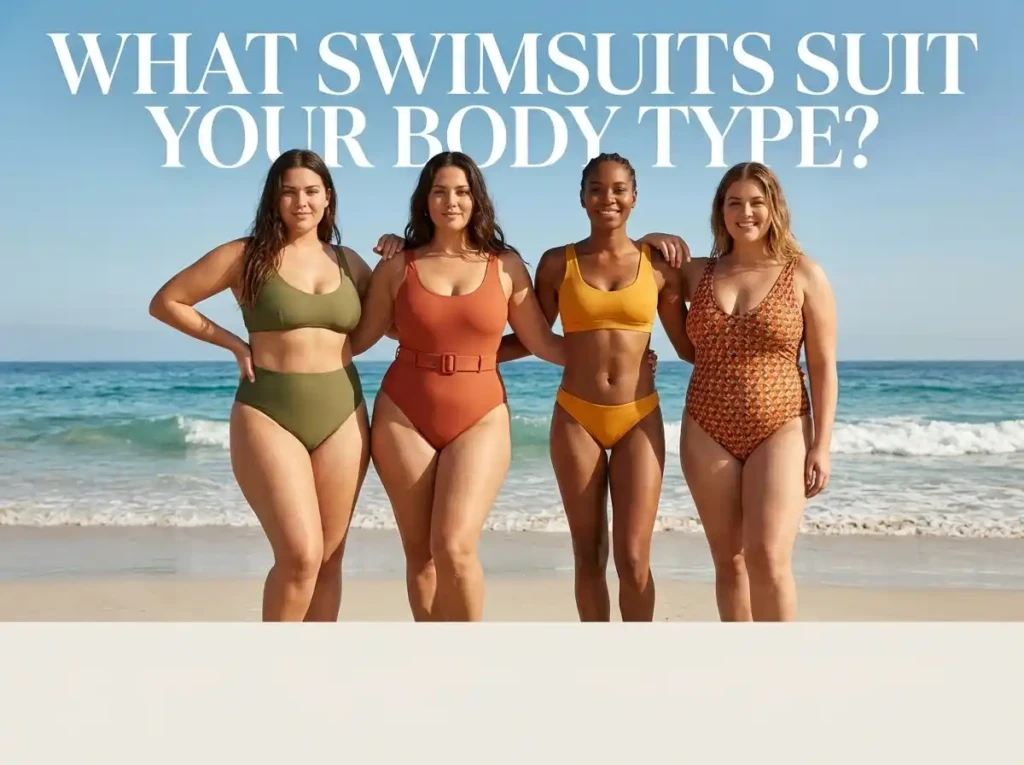
Every swimsuit guide promises to find your “perfect match” based on body shape, and most of them are half right. The general idea — that certain cuts balance certain proportions — is genuinely useful. But body-type guides tend to oversell certainty, as if there’s one correct answer for “pear shape” and everyone with that label should buy the same suit. They shouldn’t. Height, torso length, personal comfort with coverage, and honestly just what you feel good in all matter as much as the shape category itself.
With that caveat out of the way, here’s what actually tends to work for each general body type, and where I think the standard advice gets too rigid.
I’ll also say this upfront: these categories were never meant to be exact science. Most bodies are a mix — closer to one shape on a good day, closer to another after a different season of training or just normal weight fluctuation. Treat the categories below as five reference points on a spectrum, not five boxes you need to fit into precisely before any of this advice applies to you.
Pear Shape
If your hips and thighs are wider than your shoulders and bust, the usual advice is to draw attention upward and minimize the lower half. That part is sound. Tops with detail — a brighter color, ruffles, a halter neck, or a bit of padding — pull the eye up. Bottoms in solid, darker tones with moderate coverage do the “minimizing” work without looking like you’re hiding.
Where I’d push back: high-waisted bottoms get recommended constantly for pear shapes, and they do smooth the hip-to-waist line, but they’re not universally flattering just because a guide says so. On a shorter torso, a very high waist can visually shorten the leg line instead of lengthening it. If that’s happened to you in a high-waisted suit, it’s not that high-waisted is wrong for pear shapes — it’s that the specific height of that particular cut didn’t match your proportions.
Asymmetrical one-shoulder tops are a genuinely good trick for pear shapes that doesn’t get mentioned enough. They create visual width at the top without looking like you’re trying to hide anything below.
Apple Shape
Apple shapes carry more weight around the midsection, with arms and legs often proportionally slimmer. The common advice is to find suits with built-in structure around the middle — ruching, shirring, or a wrap-style front — which genuinely does smooth and define a waistline that a flat, unstructured fabric won’t.
One-piece suits with a deep V-neck or a slight cutout at the waist do double duty: the V draws a vertical line that lengthens the torso, and a side cutout, even a small one, creates the illusion of a defined waist where the suit itself doesn’t have one stitched in. Tankinis get recommended a lot for apple shapes too, mostly because they offer more coverage, but I think they’re overrated here specifically. Loose tankini fabric without structure can add bulk rather than disguise it. A structured one-piece usually does more for the same coverage goal.
Empire waist suits — fitted under the bust, flowing below — are the other reliable option, especially for anyone who wants coverage without the suit clinging anywhere.
Hourglass Shape
Hourglass figures have a defined waist with bust and hips roughly balanced. The standard advice here is almost suspiciously simple: most things work, as long as the suit doesn’t hide the waistline you already have. That’s true, but it comes with a real risk — hourglass shapes can end up in suits that are too busy, because “anything works” gets read as “add everything.”
A defined waist is the one feature worth protecting in styling choices. Belted one-pieces, wrap bikini tops, and high-cut bottoms all do this by keeping a visible line at the narrowest point. Avoid boxy, straight-cut tankinis or shapeless one-pieces — not because they look bad on everyone, but specifically because they erase the one proportion an hourglass shape already has working in its favor.
Underwire or molded-cup bikini tops are worth the extra cost here if bust support matters to you; they hold shape through actual swimming, not just standing on a towel for photos.
Athletic or Rectangle Shape
If your bust, waist, and hips are similar in width, with less natural curve between them, the usual goal is creating the appearance of curve rather than hiding anything. Ruffles, peplum hems, and bandeau tops with ties or embellishment add visual width at bust or hip level, which creates contrast against the waist even where the actual measurement difference is small.
High-waisted bottoms genuinely work well for this shape more reliably than they do for pear shapes, since there’s less risk of shortening a leg line that’s already balanced by the rest of the proportions. Cutout one-pieces with strategic cutouts at the waist do something similar to what they do for apple shapes — creating the illusion of definition where the suit’s structure, not your actual body, is doing the work.
One thing rectangle-shape guides get wrong constantly: they assume the goal is always to look curvier. Plenty of people with this body type like the clean, streamlined look it already gives them and have no interest in faking curves. A simple, well-fitted one-piece in a solid color isn’t a compromise here — it’s just a legitimate style choice, not a missed opportunity.
Inverted Triangle Shape
Broader shoulders and bust with narrower hips is the mirror image of the pear shape, and the advice mirrors accordingly: draw attention to the lower half and keep the top simpler. Solid, darker-toned tops without too much embellishment avoid adding width where there’s already width. Bottoms with more detail — a fuller cut, a print, side ties, ruffles — add visual volume to the hips and balance the silhouette.
Halter tops are usually advised against for this shape because they emphasize shoulder width, and that’s generally true, but a halter with a deep enough V can offset the width by drawing a strong vertical line down the center. It’s less about banning halters entirely and more about choosing the cut carefully if you want one.
Boy-short or fuller-coverage bottoms do more visual balancing for this shape than skimpy bottoms do, simply because there’s more fabric to read as “volume” against a broader top half.
A Note on Color and Print
Pattern advice gets repeated so often it’s basically folklore at this point: horizontal stripes widen, vertical stripes lengthen, dark colors slim, bright colors expand. Some of this holds up under actual visual perception research, and some of it is closer to an old wives’ tale that’s been repeated so many times it sounds like fact.
What’s actually well-supported is contrast placement, not color or stripe direction in isolation. A bold print concentrated at the bust or hip, with a plain panel through the waist, creates a waistline illusion regardless of body type, because the eye reads contrast as a boundary. A busy print spread evenly across the entire suit does the opposite — it flattens the whole silhouette into one visual block, which can work against you no matter your shape.
Dark, slimming colors are real, but they’re not magic. A poorly fitted suit in black still looks poorly fitted; it just looks poorly fitted in a less noticeable color. Fit comes first. Color is the finishing touch, not the fix for a cut that doesn’t work for you.
The Part Every Guide Skips
Fabric and fit do more work than cut alone. A suit in the “right” silhouette for your body type, made from a thin, unlined fabric that loses shape after one swim, will look worse than a “wrong” silhouette in a well-constructed fabric that holds its shape and supports you properly. Lining matters. Stitching quality matters. Whether the suit was actually designed for swimming, versus just looking good in a photo on dry land, matters more than almost anything on this list.
Comfort also overrides the chart, every time. If a recommended cut makes you spend the whole day adjusting straps, tugging at the bottom, or worrying about coverage, it’s not actually flattering you, no matter what the silhouette theoretically does. The most flattering thing a swimsuit can do is let you stop thinking about it.
Bottom Line
Body-type swimsuit advice is a reasonable starting point, not a rulebook to follow exactly. The categories above describe tendencies, not guarantees, and most people don’t fit neatly into one shape anyway — height, torso length, and personal proportions shift the advice in small but real ways. Use the general direction as a guide when you’re shopping with no idea where to start, but trust what actually looks and feels good on you over what a chart says should.