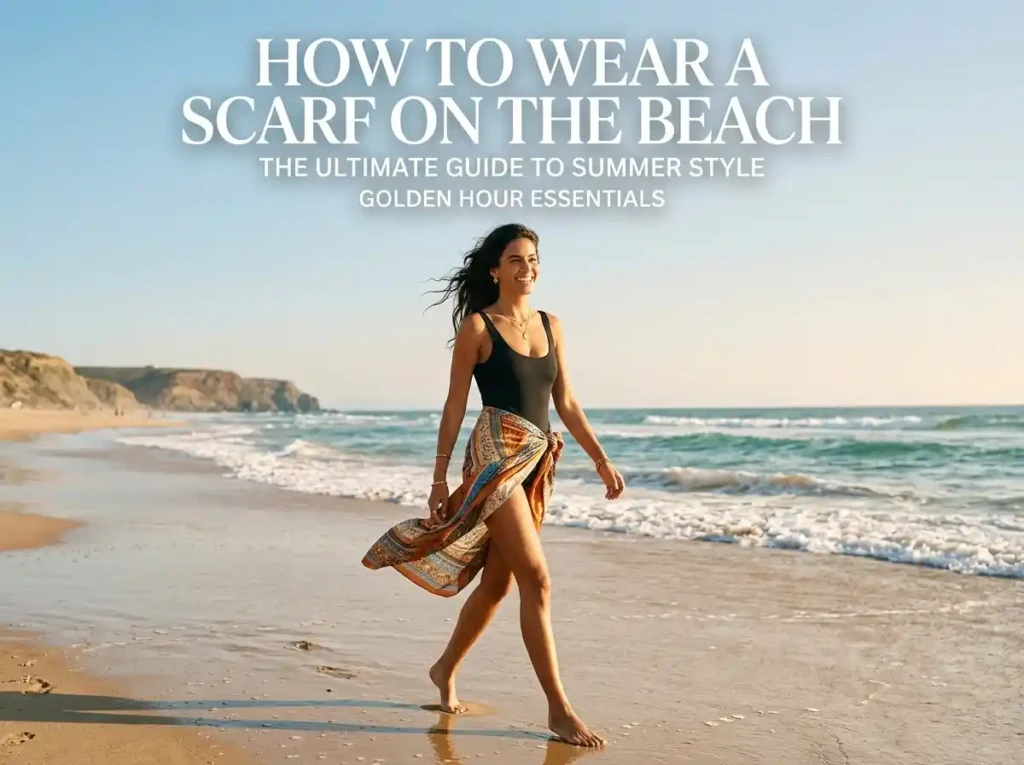
A scarf is the most underrated thing in a beach bag. It weighs almost nothing, takes up less space than a rolled-up towel, and does the job of about four separate items — cover-up, hair accessory, sun protection, sometimes even a makeshift bag. I started bringing one on every beach trip a few years ago, mostly by accident, and now I genuinely forget how I managed without it.
The reason scarves work so well on the beach is the same reason they’re slightly intimidating: there’s no single correct way to wear one, and that openness can feel like a problem when you’re standing in front of a mirror trying to figure out what to do with a rectangle of fabric. Here’s what actually works, broken down by the four ways I’d reach for one, plus the fabric and sizing details that make or break all of them.
The Sarong
This is the most obvious use and still the one most people get slightly wrong. A scarf tied as a sarong should sit at the waist or just below it, not pulled up high like a dress. Wrap it around your hips, cross the ends, and tie them either at the side or center front — side ties tend to sit flatter and move less when you’re walking on sand.
The size of the scarf matters more here than in any other use. A small square scarf, the kind sized for your neck or hair, will not wrap around your hips with enough overlap to stay secure, and you’ll spend the whole walk to the water readjusting it. You want something closer to a rectangular pareo size — long enough to wrap around and overlap by a few inches, not just barely meet at the tie point.
If you want it to double as a light cover-up rather than just a hip wrap, tie one end higher, around your ribs instead of your waist, and let it fall like an asymmetrical skirt. It’s a small adjustment but it changes the whole silhouette from “beach towel substitute” to something that actually looks styled.
The Head Wrap
A scarf tied around your head solves a real problem — hair whipping around in beach wind and getting sticky with sunscreen and salt — and it looks intentional rather than like you’re just trying to avoid a bad hair day, which is honestly half the appeal.
The simplest version: fold the scarf into a long triangle or band shape, place the center at your hairline, and tie the ends at the nape of your neck or, for a slightly more dramatic look, knot them at the top of your head like a turban. Silk and silk-blend scarves slide more than they should for this, which sounds counterintuitive since silk feels luxurious, but the same smoothness that makes it nice against skin makes it slippery against hair. A lightweight cotton or rayon scarf actually holds a head wrap better through a few hours outdoors.
One practical note: tying it tighter than feels comfortable in the first thirty seconds is usually right. Scarves loosen slightly with movement and heat, so a wrap that feels just-right when you tie it often feels loose an hour later.
The Halter Top Swap
Tying a scarf halter-style over a bikini top, or as a stand-in cover-up across the chest, is the trick I use most because it solves the actual problem of beach cover-ups — they’re bulky to pack and usually end up damp and sandy by the end of the day, while a scarf dries faster and weighs nothing extra in a bag.
To tie it: fold the scarf into a long band, hold it across your chest, bring the ends up and around your neck, then tie behind your neck like a halter strap. The width of the fold determines how much coverage you get — fold it wider for more like a top, narrower for something closer to a decorative accent over a bikini you’re already wearing.
This one depends more on fabric than the others. A scarf with some structure — a slightly thicker cotton, a linen blend — holds its shape across the chest better than something very thin and slippery, which can shift or loosen as you move. If you only own delicate silk scarves, this isn’t necessarily the use to reach for first; save those for hair or accessory styling instead.
The Ponytail or Hair Tie Wrap
This is the lowest-effort option and probably the one I’d recommend to someone trying scarves on the beach for the first time. Tie a long, thin scarf around a regular ponytail or low bun, just like a ribbon, and let the ends hang or tie them in a small bow. It takes about ten seconds and instantly looks more finished than a plain hair tie, especially in beach photos where a plain elastic just reads as “nothing.”
Thin, narrow scarves work best for this specifically, since a wide scarf bunches awkwardly around a ponytail base instead of wrapping cleanly. If you’ve got one slightly worn-out scarf you don’t trust as a sarong anymore because the fabric has stretched, this is a good second life for it.
What Fabric Actually Matters For
Most scarf-styling advice skips fabric entirely and just shows photos, which is how people end up with a beautiful silk scarf that’s genuinely the wrong choice for half of these uses. Cotton and linen scarves hold knots better and dry faster after getting wet, which matters constantly at the beach. Silk looks elevated and drapes beautifully for a sarong or a loosely tied accessory, but it’s slippery for head wraps and shows water spots and sunscreen stains more visibly than cotton does.
If you’re buying a scarf specifically to bring to the beach rather than repurposing one from your closet, a lightweight cotton or rayon blend in a print rather than a solid color is the most versatile choice. Prints hide the inevitable sand, sunscreen smudges, and salt water spots far better than a solid color does, especially in pale shades.
Common Mistakes
The biggest one is tension — tying a sarong or head wrap too loosely because you’re worried about it feeling too tight. Loose knots on a humid, windy beach come undone within the hour. Tie it firmer than feels necessary in the first minute.
The second is choosing a scarf based purely on how it photographs folded on a hanger rather than how it behaves once you’re actually moving. A scarf that looks gorgeous draped in a store can be a nightmare to knot securely if the fabric is too slippery or too small for the use you have in mind.
The third is bringing only one scarf and expecting it to do every job on this list. A single scarf can absolutely do double or triple duty over a beach day, but the sizing and fabric that make a great sarong don’t always make a great head wrap. If you’re someone who actually uses scarves often at the beach, having one slightly larger cotton scarf for wrapping and one smaller, thinner one for hair ends up more useful than a single “do everything” piece.
One More Use: Tying It to Your Bag
If you’ve still got a scarf left over after picking one use for your hair or hips, tying it around the handle of a beach tote or basket bag is a small thing that does more than people expect. It dresses up a plain canvas bag, and more usefully, it makes a generic tote instantly recognizable from a distance on a crowded beach, which sounds minor until you’re scanning a row of identical bags trying to find yours.
A long, thin scarf works better here than a wide one — wrap it once or twice around the handle and tie a simple knot, leaving the ends loose enough to flutter a bit in the wind. It’s the lowest-stakes way to experiment with a new scarf before committing it to hair or hip duty, since there’s no tension or fit to get wrong.
Bottom Line
A scarf earns its place in a beach bag by being more flexible than almost anything else you’d pack — sarong, cover-up, head wrap, hair accessory, all from one piece of fabric that takes up no real space. The styling itself isn’t complicated once you know the basic ties, but fabric choice and knot tension are what separate a scarf that holds up through an actual beach day from one that you spend the whole afternoo