Not a wellness lecture. Just what the research actually says.
I have spent a lot of money on serums. Most of us have. And I am not saying stop — some of them genuinely work. But I kept noticing that the weeks my skin looked best were not always the weeks I was most consistent with my routine. They were the weeks I was eating well. Actually sleeping. Not living on coffee and toast.
That is not a coincidence. Skin is a living organ. It needs nutrients the same way your heart and liver do, and when it does not get them, it shows. Collagen breaks down faster. Cells do not renew properly. The barrier gets weak and suddenly everything irritates you. No serum fixes a nutritional gap.
The frustrating part is that diet advice for skin is usually either too vague to be useful (“eat more greens!”) or buried in studies that nobody has time to read. So here is the version that cuts through both problems. Eight vegetables, specific reasons, actual evidence. Not a list of superfoods. Just the ones that have real jobs to do.
Start here.
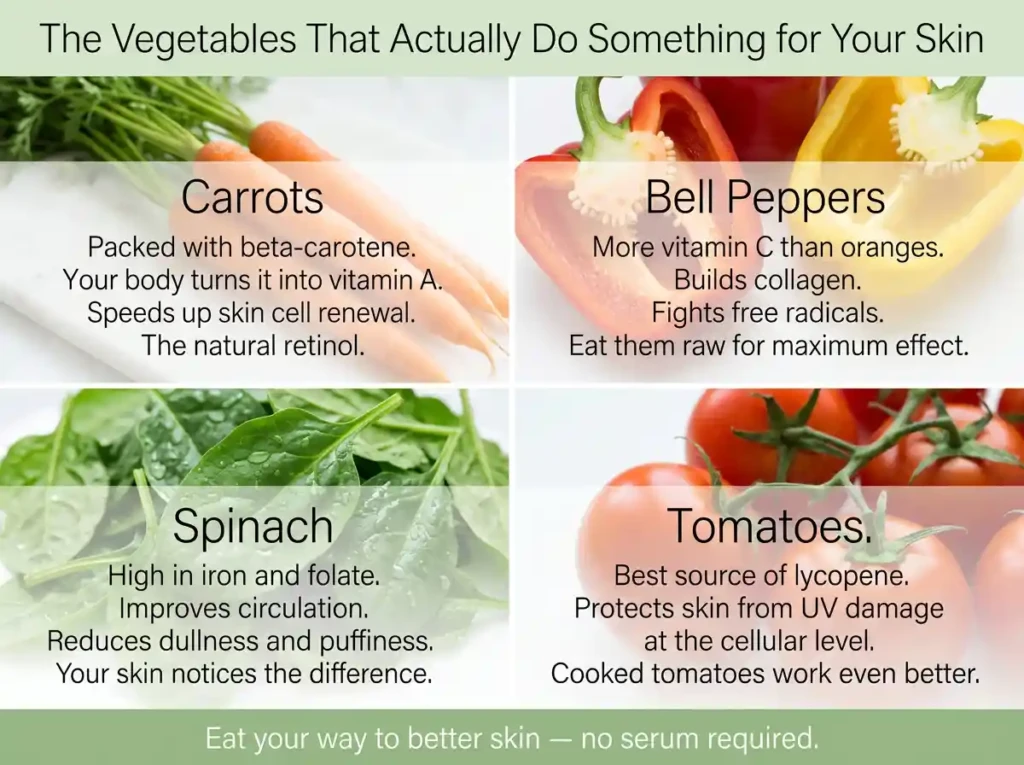
Carrots
Here is something that does not get said enough: retinol, the ingredient that dermatologists keep recommending, is a synthetic form of vitamin A. And you get vitamin A from beta-carotene. And carrots are full of beta-carotene. The path from carrot to clearer skin is not a wellness myth — it is straightforward biochemistry.
Vitamin A speeds up skin cell turnover. Old cells out, fresh ones in. When turnover slows down — which happens with age, stress, and low vitamin A intake — skin looks dull, pores clog more easily, and spots take longer to fade. One medium carrot gives you more than your daily recommended amount of beta-carotene.
One small tip: cook them. Heat breaks down the cell walls and makes the beta-carotene easier for your body to absorb. A quick roast or steam is actually more effective than eating them raw, which is not something you can say about most vegetables.
Sweet Potatoes
If carrots are good, sweet potatoes are better. More beta-carotene per gram, plus vitamin C on top of it. That matters because vitamin C is what your body uses to build collagen — and collagen is what keeps skin firm, bouncy, and healing properly. You cannot eat your way to a facelift, but you can absolutely eat your way to collagen breakdown if your vitamin C intake is chronically low.
What I like about sweet potatoes is how easy they are to actually eat. Roasted with olive oil, mashed, thrown in a curry — they go with everything and they taste good enough that you do not feel like you are doing penance for your skincare routine. Getting both vitamin A precursors and vitamin C from one food is a decent deal.
Spinach
Poor circulation is one of those things that nobody talks about in the context of skin, but it matters a lot. When blood is not moving well, the face is one of the first places it shows — dullness, puffiness, slow healing after spots. Spinach is high in folate and iron, both of which support healthy circulation. If your skin has looked flat and tired lately and you cannot explain why, your iron levels are worth looking at.
It also has lutein and vitamin E, which work together as antioxidants. A 2011 study in Clinics in Dermatology found that women over 40 with high antioxidant diets showed measurably less skin aging than those without. That is not a dramatic finding — it will not reverse ten years overnight — but it does confirm that eating spinach consistently over time is doing something real, not just something theoretical.
Tomatoes
Technically a fruit. I know. But it belongs here because of lycopene, which is the most interesting sun-protection nutrient most people have never heard of. Lycopene is an antioxidant that absorbs UV radiation at the cellular level. A 2008 study in the British Journal of Dermatology found that people who ate tomato paste every day for 12 weeks had 33% more protection against sunburn than the control group.
To be clear: that does not mean eat tomatoes instead of wearing SPF. It means tomatoes add a layer of protection that SPF alone does not cover — the cellular, inside-out kind. Think of it as a backup system, not a replacement.
Here is the part that surprises people: cooked tomatoes have more bioavailable lycopene than raw ones. Heat breaks down the cell walls and releases it. Tomato paste, canned tomatoes, a simple pasta sauce — all of these count. This is one of the rare cases where the processed version is actually better for a specific nutrient than the fresh one.
Broccoli
Broccoli has a compound called sulforaphane that I think deserves more attention. It activates a protective response in skin cells against UV damage, which is interesting on its own. But sulforaphane also has serious anti-inflammatory properties — and inflammation is underneath a lot of skin problems that people treat topically without getting anywhere.
Acne, rosacea, eczema — all of these involve chronic inflammation at the skin level. A dietary pattern that keeps inflammation low tends to help with all of them, not just one. If you want to get more sulforaphane than regular broccoli provides, broccoli sprouts are the shortcut. They have significantly higher concentrations and are easy to add to salads or sandwiches. The vitamin K in broccoli is also worth a mention for anyone dealing with dark under-eye circles or bruising easily.
Bell Peppers
Red bell peppers have more vitamin C than oranges. I genuinely did not believe this the first time I read it. One medium red pepper delivers around 150mg of vitamin C, comfortably above the recommended daily intake of 65 to 90mg. The orange and yellow ones are close behind. Green peppers have much less — they are just unripe red ones picked early.
Vitamin C is doing two things here: building collagen and neutralising free radicals from sun and pollution. Both matter. One thing to keep in mind — vitamin C degrades with heat, so raw peppers deliver more of it than cooked ones. Slicing them up as a snack instead of roasting them is actually the smarter move if you are specifically trying to maximise the skin benefit.
Cucumber
Cucumber is 96% water, which sounds like a joke but is actually the whole point. Skin hydration is not primarily about what you put on your skin — it is about what you put in your body. Moisturisers trap water in the outer layers. But if you are genuinely dehydrated, no cream fixes that from the outside. The skin will look dull, feel tight, and fine lines will look more pronounced than they actually are.
If you are someone who forgets to drink water — and most people are — water-rich foods make a real difference. Cucumber, celery, zucchini, lettuce. None of them are dramatic on the micronutrient front, but they contribute to your hydration in a way that is easier to maintain than forcing yourself to drink more glasses of plain water. Cucumber also has small amounts of silica, which some research links to skin elasticity, though the evidence there is less solid than the hydration benefit.
Kale
Kale is one of those foods that got overhyped to the point where people started dismissing it, which is a shame because it actually earns its reputation. Vitamins A, C, and K in one place, plus plant-based omega-3 fatty acids. The fats are the part that most people do not think about in the context of skin.
Dry, flaky, reactive skin is often a sign that the skin barrier is compromised — and the barrier depends on fatty acids to stay intact. When it is weak, moisture escapes and irritants get in. Products sting that should not. Redness appears for no obvious reason. Omega-3s help rebuild and maintain that barrier over time. Kale is not the richest source — fatty fish and walnuts beat it easily — but if you are eating plant-based or just adding variety to your diet, it covers multiple nutritional bases at once. If you hate kale specifically, cavolo nero and Swiss chard do a similar job.
What to Actually Do With This
Nobody’s skin is going to transform in a week from eating more broccoli. That is not how this works. The changes that come from diet are slow, cumulative, and easy to miss until one day you realise your skin has been clearer for six months and you cannot point to a new product that explains it.
The pattern across all eight of these is consistent: antioxidants protect against damage from sun and pollution, vitamins A and C handle renewal and collagen, hydration keeps the whole system functioning, and healthy fats maintain the barrier. You do not need all eight every day. Eating variety across the week — more colour, more diversity — covers the bases without turning dinner into a skincare supplement.
The one thing I would add: consistency matters more than optimisation. Eating spinach and peppers most days of the week does more for your skin than finding the single most lycopene-dense tomato variety and eating it once. The body is not tracking individual meals. It is working with whatever pattern you give it over weeks and months.
Eat a variety. Drink enough water. And yes — still wear the SPF.