A few years ago my dermatologist told me something I haven’t been able to shake since. She said she can usually tell which side of someone’s face gets more sun just by looking at it — no questions asked, no history taken. Truck drivers are her favorite example. The window-side cheek ages completely differently than the other one. Same person, same genes, same diet, same everything. One side just saw more light.
That’s the whole pitch, honestly. I could stop the article there and you’d probably get it. But let’s go deeper, because I didn’t believe it either until I actually looked into the why.
I used to be a beach-and-pool-only sunscreen person. Slather it on in July, forget it exists by Labor Day. Which, it turns out, is exactly backwards. UV rays don’t know what month it is. They don’t care if you’re at the lake or sitting at your kitchen table three feet from a window doing absolutely nothing.
Okay, so what is it actually doing
Sunscreen’s job is simple: stop ultraviolet radiation before it reaches the living layers of your skin. There are two types worth knowing — UVA and UVB. UVB is the one that burns you, the obvious villain, the reason you turn lobster-red after a day at the beach without protection. UVA is sneakier. It goes deeper, chews through collagen, and is mostly responsible for wrinkles, sagging, and those brown spots that show up uninvited in your thirties and forties.
One dermatologist summed it up for me in four words: UVB burns, UVA ages. I think about that phrase more than is probably normal.
Here’s the part that actually changed my behavior, though — you don’t need to get burned for the damage to count. It’s not a binary, burn-or-fine situation. Low-grade exposure, day in and day out, for years, quietly stacks up. Nobody feels their skin aging in real time. You just wake up one day and there’s a spot that wasn’t there last summer, or your skin feels thinner than it used to. By then the damage already happened. There’s no rewind button on UV exposure.
The cancer part, which I’m not going to soften
I’ll just say this straight: skin cancer is the most common cancer in the U.S., and the overwhelming majority of cases come down to UV exposure. Not bad luck. Not just genetics. Mostly sun.
The American Academy of Dermatology points to a long-running Australian study — people tracked for over a decade — that found daily sunscreen use cut squamous cell carcinoma risk by around 40 percent and melanoma risk by about 50 percent.
Sit with that for a second. Half. From a habit that takes fifteen seconds and costs less than your coffee. I genuinely cannot think of another daily thing in my life with that kind of return. Flossing doesn’t do that. Going to the gym doesn’t do that, not at that magnitude. And yet sunscreen gets treated like an optional summer accessory instead of, you know, one of the few things actually proven to cut cancer risk in half.
Part of the problem is that none of this feels urgent. The damage is invisible for decades. You don’t see it happening, so it’s easy to pretend it isn’t. You just get the bill later — a mole that suddenly needs checking, a biopsy you didn’t see coming.
If cancer doesn’t move you, fine, here’s the vanity argument
Some people care more about wrinkles than cancer statistics, and look, I’m not going to pretend that’s irrational. Whatever gets sunscreen onto your face, I’m for it.
So: up to 80 percent of visible skin aging is caused by sun exposure. Not genetics. Not just “getting older.” Mostly the sun. This is called photoaging, and it explains why two siblings raised in the exact same house can look a decade apart by their forties — one wore sunscreen, one didn’t, same DNA, wildly different results.
That truck driver photo my dermatologist mentioned? It’s a real thing, and dermatologists pull it up constantly because it’s the cleanest before-and-after you’ll ever see without running an actual experiment. One cheek got decades of low-dose UVA filtering through a windshield. The other one didn’t. The difference isn’t subtle.
And this is the detail that actually got me to change my habits — UVA goes through windows. Through clouds. Through a lot of fabric, too. “I was inside all day” doesn’t mean what people think it means.
Okay, but which sunscreen
Not all of them are equal, and the bottle labels are genuinely confusing if nobody’s ever explained them to you. I had no idea what half this stuff meant for years.
Broad spectrum means it covers both UVA and UVB. If a bottle doesn’t say “broad spectrum,” skip it — it’s probably only stopping the burn-causing rays while leaving the aging, cancer-linked ones to do whatever they want.
SPF measures UVB protection specifically. SPF 30 blocks about 97 percent of UVB. SPF 50 blocks about 98 percent. That one-percent jump surprises people every time — it’s nowhere near double the protection the number might suggest. Most dermatologists land on SPF 30 or higher for daily wear, and higher if you’re going to be outside for a while.
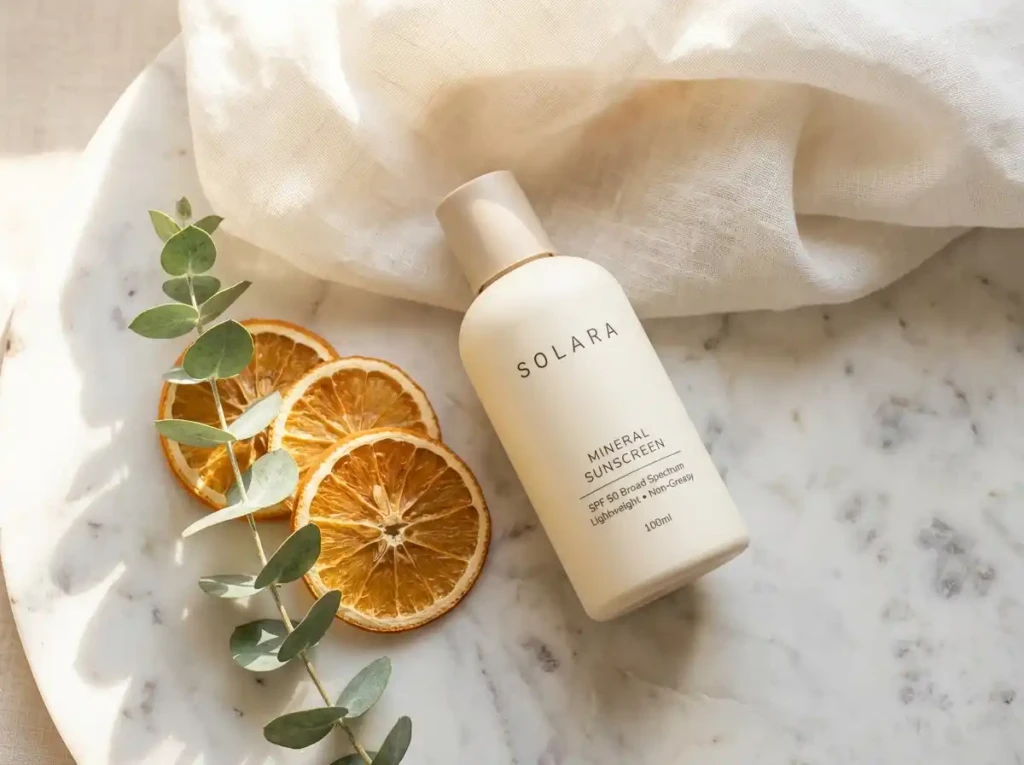
There’s mineral (zinc oxide, titanium dioxide) and chemical (avobenzone, octinoxate, a handful of others). Mineral sits on the surface and physically deflects UV. Chemical absorbs the radiation and turns it into heat. Neither one wins across the board — it really depends on your skin. If you’ve got sensitive skin or rosacea, mineral formulas tend to be the gentler choice. I switched to mineral two summers ago and my skin noticeably stopped getting irritated.
The part everyone gets wrong: how much, how often
Most people use less than half the amount needed to actually hit the SPF printed on the label. The real guidance is roughly a shot glass for full body coverage, and about a quarter teaspoon just for your face and neck. That sounds like a lot until you actually measure it out once and realize how little you’ve been using your whole life.
Reapplying matters as much as putting it on in the first place. Sunscreen degrades under UV exposure and rubs off from sweat, water, towels, your own hands touching your face fifty times a day without you noticing. The two-hour reapplication window isn’t a marketing gimmick — it’s roughly how fast most formulas actually break down.
If you’re stuck indoors all day with zero window exposure, fine, you’ve got more wiggle room. But the second there’s a window nearby, or you step outside for five minutes, the math shifts.
A few myths I’d like to personally retire
“I have dark skin, I don’t need it.” Melanin gives you something — roughly the equivalent of SPF 13 in very deeply pigmented skin — but that’s nowhere close to enough on its own. People with darker skin still get skin cancer. Often later, because it gets caught later, which makes outcomes worse, not better. Hyperpigmentation gets worse with UV exposure too, regardless of your skin tone.
“It’s cloudy, I’m fine.” Up to 80 percent of UV rays pass straight through cloud cover. Cloudy days feel safer because they feel cooler. That feeling is lying to you.
“I already have a base tan.” A tan isn’t protection, it’s your skin’s visible injury response. If you’re tanning, damage is already happening at the cellular level. There’s no such thing as a “safe” tan, no matter how many times that phrase gets thrown around.
Where I actually land on all this
I’m not going to pretend I love sunscreen. Some formulas feel like wearing a thin layer of plastic. I went through something like six bottles over the past two years hunting for one that wouldn’t pill up under makeup, and I’m still not 100 percent settled on my favorite. This isn’t a sponsored love letter to SPF.
But the math just isn’t close. Fifteen seconds, under a dollar a day, and a real, measurable drop in cancer risk and visible aging. I don’t know of many habits with that kind of payoff for that little effort.
That truck driver photo is the thing that sticks with me, more than any statistic. Same person. Same genes. Decades of visible difference, explained entirely by a pane of glass. That’s not a hypothetical. That’s what’s quietly happening to your skin right now, whether or not you’re paying attention to it.