What you put in your mouth shows up on your face. Eventually.
I spent years buying serums and treatments and then eating whatever I wanted and wondering why my skin never looked as good as I felt like it should. The products were fine. The diet was the problem. Not in a dramatic way — I wasn’t eating terribly — but I wasn’t eating the things that actually feed your skin from the inside, which is the part that shows up in the mirror three weeks later whether you remember eating them or not.
Skin is the last organ to receive nutrients. Everything you eat gets distributed to the heart, the brain, the liver first. Your skin gets what’s left over. Which means if you’re barely getting enough of the good stuff, your skin is the first place that deficit shows up — dullness, dryness, slow healing, that vague sense that your complexion isn’t quite right that no amount of moisturizer fixes.
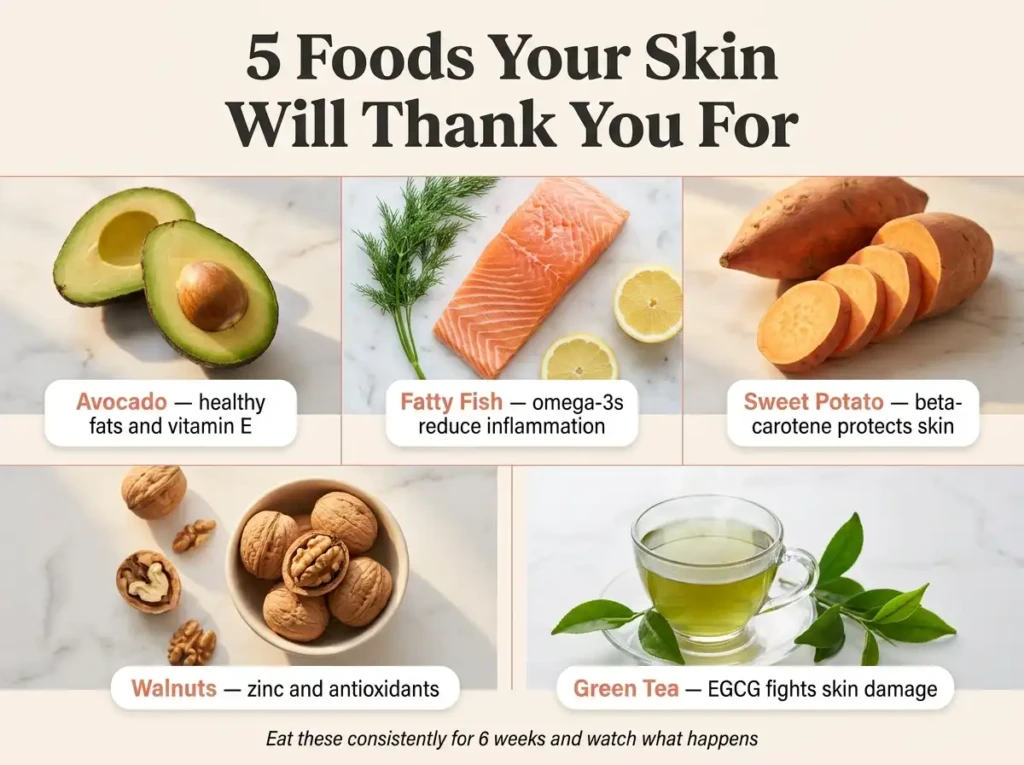
The five foods below are the ones that made a noticeable difference for me when I started eating them consistently. Not occasionally. Consistently. That word does a lot of work in nutrition and I’ll keep using it because results from food are slow and cumulative in a way that makes people quit before they see anything. Give it six weeks. You’ll see it.
1. Avocado — The Fat Your Skin Is Literally Begging For
There was a period where I avoided avocado because I was convinced the fat content was the enemy. This was wrong and I have the dry skin from that era to prove it. Avocado is high in monounsaturated fats — the same type found in olive oil — and those fats are exactly what your skin barrier is made of. Without enough dietary fat, the skin barrier becomes compromised. It can’t hold moisture properly. It gets dry, reactive, and prone to irritation from things that wouldn’t normally bother it.
Avocado also contains vitamin E, which is a fat-soluble antioxidant that protects skin cells from oxidative damage. Vitamin E works better when paired with vitamin C — and avocado has some of that too, though not as much. The combination matters because vitamin C regenerates vitamin E after it’s been used up fighting free radicals. They work as a team, which is why whole foods tend to outperform single supplements.
There’s also the biotin angle. Avocado is one of the better dietary sources of biotin, the B vitamin that supports keratin production in skin, hair, and nails. You hear about biotin supplements constantly. The food version works too, without the megadose concerns that come with supplements.
How to actually eat it consistently: on toast, yes, but also blended into smoothies where you can’t taste it at all, mashed into scrambled eggs, sliced onto anything savory. Half an avocado a day is enough to make a difference. The other half keeps overnight in the fridge with the pit in and a squeeze of lemon on the cut surface. It browns a little but it’s fine.
2. Fatty Fish — Salmon, Sardines, Mackerel, Pick One
If there is one dietary change with the most consistent, most documented effect on skin health, it’s adding omega-3 fatty acids. The research on this is not ambiguous. Omega-3s reduce inflammation throughout the body, support the skin barrier, regulate oil production, and protect against UV-induced skin damage. People who eat fatty fish regularly have measurably lower rates of inflammatory skin conditions. Dermatologists have been saying this for twenty years.
Salmon is the most popular option and it works well, but sardines are arguably better value — cheaper, more sustainable, higher in omega-3s per gram, and if you buy them in olive oil and eat them on crackers with a little lemon and hot sauce they’re genuinely good. I know sardines have a reputation. I’m asking you to give them another chance. Mackerel is the third option if you want something in between.
The reason you need this from food rather than just a supplement: fish oil supplements oxidize easily, especially cheap ones, and rancid fish oil is worse than no fish oil. If you’re going to supplement, buy a reputable brand that tests for oxidation and keep the capsules in the fridge. But two to three servings of actual fatty fish per week is more reliable and comes with protein, zinc, and selenium that the supplement doesn’t include.
The skin effects take time. Six weeks of consistent intake before you notice anything. Eight weeks before it’s obvious. Your skin will look less red, less reactive, more even. The dryness that comes back every winter will be less severe. It’s the kind of improvement that people around you notice before you do because you’re looking at your face every day and the change is gradual.
3. Sweet Potato — More Beta-Carotene Than Almost Anything Else
Your skin has a natural defense system against UV damage. It’s not as good as sunscreen — nothing topical is — but it exists, and beta-carotene is a big part of it. Beta-carotene is a precursor to vitamin A, which is the same compound that prescription retinoids are derived from. Your body converts the beta-carotene you eat into vitamin A and deposits some of it in your skin, where it acts as a photoprotective antioxidant.
Sweet potato is one of the highest dietary sources of beta-carotene available. One medium sweet potato contains more than your entire daily recommended intake of vitamin A. It also contains vitamin C and manganese, both of which support collagen production. Collagen is the structural protein that keeps skin firm and plump, and it degrades with age, sun exposure, and sugar consumption. Eating things that support its production is the dietary equivalent of a low-grade topical retinol — slow, cumulative, and genuinely effective over time.
The beta-carotene in sweet potato is fat-soluble, which means it absorbs better when eaten with fat. A drizzle of olive oil or a spoonful of butter on your sweet potato isn’t indulgent — it’s actually improving the nutritional value. This applies to most orange and yellow vegetables: carrots, butternut squash, pumpkin. They all work similarly and they’re all better absorbed with a little fat alongside them.
One side note: eating very large amounts of beta-carotene over an extended period can cause a harmless condition called carotenemia where your skin takes on a slightly orange tint, particularly on the palms and soles of the feet. This requires eating a lot of sweet potato every day for months. A normal portion a few times a week won’t do this. I mention it only because it occasionally shows up in articles about beta-carotene and sounds alarming when it doesn’t need to be.
4. Walnuts — The Nut That Does the Most
Most nuts are good for you. Walnuts are specifically good for your skin in a way that sets them apart from the others. They’re one of the only plant sources of omega-3 fatty acids — the same anti-inflammatory fats found in fatty fish — making them particularly useful for people who don’t eat fish. They’re also high in zinc, which is essential for skin repair and for regulating oil production.
Zinc is the mineral that gets the least attention in skin conversations but probably deserves the most. It’s involved in wound healing, in the regulation of sebaceous glands, and in protecting skin cells from bacterial infection. Zinc deficiency shows up as slow-healing skin, persistent acne, and a general roughness that doesn’t improve with topical treatment. Walnuts, pumpkin seeds, and legumes are all decent dietary sources if you don’t eat meat.
The other thing walnuts have going for them is vitamin E and polyphenols, which together provide antioxidant protection against the environmental stressors — pollution, UV, stress — that age skin faster than almost anything else. You’re not replacing sunscreen with walnuts. But you are giving your skin more tools to deal with the damage that gets through despite sunscreen.
A small handful a day — about seven to eight whole walnuts — is the amount used in most nutrition studies showing benefits. More than that doesn’t appear to add much. They’re calorie-dense, which is fine, but it’s also why a handful rather than a bowlful is the sensible portion. I keep them on my desk and eat them instead of whatever else I’d reach for at three in the afternoon. The habit took two weeks to stick. Now I don’t think about it.
5. Green Tea — Drink It Instead of a Third Coffee
Green tea contains epigallocatechin gallate, which is a polyphenol antioxidant that has more research behind it than almost any other plant compound. EGCG specifically has been studied in the context of UV protection, skin inflammation, and collagen preservation. Studies using both topical and dietary EGCG have shown reductions in sun-induced skin damage and improvements in skin elasticity. It’s the reason green tea extract shows up in so many skincare products.
Drinking it gets the compound into your system in a way that a serum can’t fully replicate. The absorbed EGCG circulates and reaches skin cells from the inside, complementing whatever you’re applying topically. Two to three cups a day is the amount most studies use. More than five cups a day and the caffeine becomes a real consideration — green tea has less caffeine than coffee but it adds up.
The hydration aspect matters too and gets overlooked. Most people are mildly dehydrated most of the time, and dehydration shows up in skin before it shows up anywhere else — dullness, fine lines that look deeper than they are, a general flatness to the complexion. Every cup of green tea is hydration plus antioxidants, which makes it more valuable than most supplements at a fraction of the cost.
If you don’t like the taste of green tea straight — and a lot of people don’t, especially the cheaper varieties that can taste grassy and bitter — try a higher quality loose leaf version brewed at a lower temperature. Water at around 75 to 80 degrees Celsius rather than boiling produces a noticeably smoother, less bitter cup. Or cold brew it overnight in the fridge. Cold brewing green tea for eight hours produces a naturally sweet, mellow flavor that converts most green tea skeptics. I was one of them.
The Honest Part
None of these foods work like a topical treatment. You won’t eat salmon on Monday and wake up with better skin on Tuesday. The timeline is weeks, sometimes months, and the improvement is gradual enough that you might not notice it happening. What you will notice is that your skin stops being as reactive, heals faster when something goes wrong, holds moisture better through winter, and has a baseline quality that your skincare routine builds on more effectively.
The other honest part: you have to eat them regularly. Adding avocado once and calling it done doesn’t move the needle. Half an avocado most days, fatty fish a few times a week, sweet potato regularly, a handful of walnuts daily, green tea instead of the third coffee — that pattern, maintained over six weeks, is what produces results you can actually see.
It’s also worth saying that this isn’t about eating perfectly. It’s about adding the things that help, not eliminating everything else. Your skin doesn’t need you to be militant. It needs you to be consistent with the good stuff. That’s a much more sustainable ask, and it’s the one that actually works long term.